
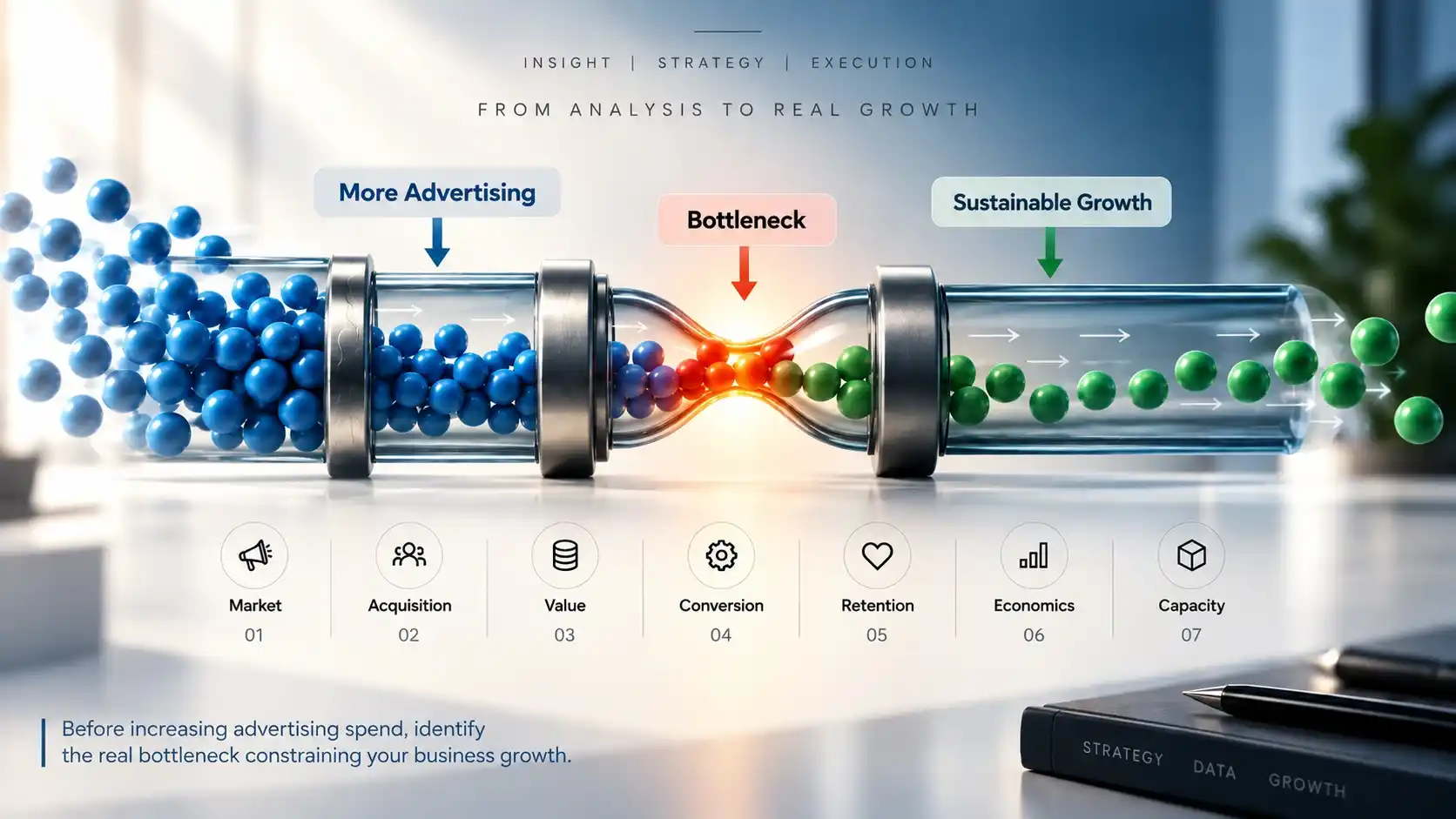
When growth or sales fall short of expectations, increasing advertising is often one of the first responses: raise the campaign budget, add another channel, or bring more leads into the funnel.
That response is not inherently wrong. In some businesses, more investment in acquisition is exactly the right move. The problem begins when we have not identified what is constraining growth, yet we increase the input anyway.
If acquisition is not the constraint, more advertising may simply make the existing bottleneck more expensive.
Low sales are an observation, not a diagnosis
Lower sales can come from insufficient demand, but they can also reflect a weak offer, poor lead quality, sales conversion, customer churn, unattractive unit economics, or organizational capacity. Under pressure to act, it is easy to move from an observation to a solution without testing the diagnosis in between.
In Harvard Business Review, Thomas Wedell-Wedellsborg reported surveys of 106 C-suite executives across 91 organizations in 17 countries: 85% agreed their organizations were poor at problem diagnosis, and 87% agreed that this weakness carried significant costs. His central observation was that managers can move into solution mode before confirming that they understand the problem.
The middle step is still a hypothesis. Before reallocating budget, look for evidence that acquisition is actually the binding constraint.
Advertising is a lever; growth is a system outcome
Imagine a business generating 10,000 visitors, 1,000 leads, 100 sales opportunities, and 10 sales per month. If 10 sales are not enough, doubling traffic is one option - but we still do not know whether it is the highest-leverage option.
Input is scarce, while conversion, retention, margins, and capacity are healthy. Acquisition may genuinely be the bottleneck.
Input is adequate, but qualified opportunities rarely close. More traffic sends more people into the same weak conversion system.
Reforge's Growth Foundations similarly treats growth as more than acquisition, bringing retention, acquisition, and monetization together in a growth model used to identify opportunities and prioritize work.
The question is not simply whether to advertise more or less. It is where the next unit of money and management attention can remove the most important constraint.
A seven-layer growth bottleneck diagnostic
This is not a linear funnel that must always be reviewed from step one to step seven. It is a diagnostic map for finding the layer that is currently placing the strongest constraint on the business outcome.
For every layer, record three things: evidence, current status, and the next test. If evidence is missing, mark the layer as unknown. An unknown is not a failure; it tells you what to investigate next.
1. Market and demand: does the problem begin before advertising?
A strong product can still target the wrong segment, solve a low-priority problem, or face weak demand. Better advertising cannot manufacture durable demand for an offer that does not matter enough to the intended buyer.
Observed demand, segment differences, purchase and non-purchase reasons, alternatives, market shifts, and signs of real pull.
Ask:If more of the right people saw the offer, would they have a compelling reason to act?
2. Acquisition: are we genuinely short of qualified input?
If the offer works, conversion is healthy, customers stay, economics are defensible, and the organization can serve more demand, a shortage of qualified input can be the true constraint.
Qualified traffic and leads, channel mix, reach, acquisition cost, and downstream quality by source.
Ask:Is insufficient qualified input actually limiting output today?
3. Value and offer: does the customer have a reason to choose us?
Sometimes advertising has already done its job. Prospects arrive, engage, request information, or ask for a quote - but they do not buy. The next investigation may belong in the product, service, offer, pricing, or value proposition.
Reasons for non-purchase, price objections, perceived differentiation, offer clarity, and early product/service experience.
Ask:Once the customer arrives, is what they see compelling enough to choose?
4. Conversion and sales: are we converting the demand we already have?
Do not hide a conversion problem with more leads. Review Lead → Qualified Lead → Opportunity → Proposal → Sale and find where the largest loss occurs.
Stage conversion, first-response time, follow-up rates, win/loss reasons, proposal quality, and performance differences across segments or reps.
Ask:Where exactly are we losing the most potential customers, and why?
5. Retention and customer: are customers arriving but failing to stay?
If the business constantly acquires new customers to replace those it loses, acquisition can look active while underlying growth remains weak. McKinsey's 2025 B2B sales analysis puts reducing churn and winning customers back ahead of scaling lead acquisition among its five acceleration levers.
Repeat purchase, renewal, churn, cohort retention, complaints, referrals, and reasons for leaving.
Ask:Are new customers creating growth, or merely replacing customers we lost?
6. Economics and cash: does more revenue create better growth?
Revenue can rise while CAC increases, margin falls, payback lengthens, or working-capital pressure grows. More sales are not automatically better growth.
CAC, gross/contribution margin, LTV where appropriate, payback period, cash flow, discounting, receivables, and working capital.
Ask:What economic quality does this growth create?
7. Capacity and organization: what breaks if demand doubles?
Marketing and sales can perform well while delivery, operations, production, support, or staffing become the constraint. Scaling acquisition in that state can degrade customer experience.
Sales capacity, delivery time, backlog, service levels, production/operations capacity, and support load.
Ask:If qualified demand doubled tomorrow, which part of the organization would fail first?
A management test before increasing advertising spend
The table below is not designed to produce a mechanical yes/no answer. Its job is to expose where evidence is strong, weak, or missing.
| Layer | Diagnostic question | Evidence to inspect |
|---|---|---|
| Market | Is there sufficient real demand? | Buyer behavior, segments, win/loss, market pull |
| Acquisition | Is qualified input genuinely scarce? | Qualified traffic/leads, channel CAC, downstream quality |
| Value | Is the offer compelling to the target customer? | Non-purchase reasons, pricing/offer feedback, activation |
| Conversion | Are we converting existing demand? | Stage conversion, win/loss, response time |
| Retention | Do customers stay, renew, or return? | Retention, renewal, repeat, churn |
| Economics | Is growth economically defensible? | CAC, margin, payback, cash/working capital |
| Capacity | Can the organization serve more demand? | Backlog, delivery time, SLA, team/operations capacity |
If you cannot answer one of these questions, you do not need months of research. Design a small test that reduces that uncertainty before making a large allocation decision.
When is more advertising actually the right decision?
A useful diagnostic should not become an anti-advertising argument. Nielsen's 2022 analysis of media plans found that 50% of planned channel investments were below the level associated with maximum ROI in its dataset. Underinvestment can be a real problem too.
Increasing advertising is a serious option when evidence suggests there is room in the market, the offer works, conversion and retention are healthy enough, economics are defensible, capacity exists, and qualified acquisition is the binding constraint.
If input is already adequate but the constraint sits in value, conversion, retention, economics, or capacity, investigate or address that constraint before materially scaling spend.
Replace the big bet with a small test
Diagnosing a bottleneck does not require perfect information. A good decision can start with sufficient evidence and improve through testing.
Which layer is the most plausible constraint based on current evidence?
If we remove this constraint, which business outcome should change?
What is the lowest-cost experiment that could meaningfully support or challenge the hypothesis?
Move beyond impressions and clicks where possible: qualified lead, sale, margin, retention.
Scale, adjust, stop, or redirect resources to the next constraint.
Advertising is an important growth lever, but it is not growth itself. When results fall short, a better first question than "What should we do more of?" is: "Which part of the system is limiting the outcome, and what evidence supports that diagnosis?"
Sometimes the answer is more advertising. Sometimes it is sales, the offer, customer retention, economics, or organizational capacity. The objective is not more activity; it is the intervention with the highest real leverage at that point in time.
Terms used in this article
Concise definitions for specialist terms used in this article.
One-page Growth Bottleneck Diagnostic
Review all seven layers on one page, record the evidence, identify the suspected bottleneck, and define the next test. It is designed to be used in a management meeting.
Download the Growth Bottleneck DiagnosticIf the problem is more complex than a checklist
If it is still unclear whether the primary constraint sits in the market, product, marketing, sales, customer, economics, or organization, we can discuss the problem.
Start a professional conversation