

When sales decline, solutions tend to enter the conversation quickly: increase advertising, change the price, hire another salesperson, offer a discount, or modify the product.
But a more important question comes first: Are we choosing a solution for the problem that is actually happening?
One of the costliest management errors is selecting a solution before the problem has been diagnosed. Before asking “What should we do?”, we should be able to say, with evidence, what is not working, where it is happening, and under what conditions.
Why teams can move into solution mode too early
In Harvard Business Review, Thomas Wedell-Wedellsborg reported a survey of 106 C-suite executives representing 91 organizations in 17 countries. Eighty-five percent agreed that their organizations were poor at problem diagnosis, and 87% said the weakness carried significant costs. This sample should not be treated as representative of every company or market, but it illustrates an important management pattern: teams can move into solving mode before they have established that they understand the problem.
In another Harvard Business Review article, Julia Binder and Michael D. Watkins emphasize problem framing: examining and defining the problem from multiple perspectives before jumping to solutions.
Speed alone is not an advantage. If the problem has been framed incorrectly, faster execution can simply move the organization faster in the wrong direction.
Separate the signal, the problem, and the cause
“Sales are down” is an important observation, but it is not yet a diagnosis. “Conversion has fallen” is the same. These statements tell us that something changed; they do not tell us why.
What changed? For example, revenue declined.
Where is the change visible? For example, mostly among new customers in one product or channel.
What plausible explanations could account for the change?
What strengthens or weakens each explanation? What is still missing?
Given the evidence available now, what can we reasonably say—and what remains uncertain?
Before asking “why?”, ask “where exactly?”
Asking “Why are sales down?” can produce dozens of answers: pricing, advertising, lead quality, sales execution, product, competition, market conditions, or customer experience.
But if we first establish that the decline is concentrated among new customers, in Product A, through one channel, and began around a specific date, the search space becomes much smaller.
Describe the metric or behavior as precisely as possible.
The previous period, a multi-period average, the same period last year, a target, or another valid comparison point.
Customer, product, channel, region, team, or process stage.
Location is not cause. If the decline appears in one channel, that does not prove the channel caused it. It tells us where to narrow the investigation.
Without a baseline, a “decline” may still be an impression
To say that something improved or deteriorated, we need a meaningful comparison. A single number is rarely enough for a management decision.
For example, $62,000 in sales is neither good nor bad on its own. If the comparable period was $85,000, there is a meaningful change to investigate. If the business normally fluctuates between $58,000 and $65,000, the same number means something different.
Not having a baseline is not a failure. It is an evidence gap that should be addressed before a costly decision.
Build competing explanations instead of choosing one cause too early
Once the location of the change is clearer, the next step is not to select a cause immediately. Keep several plausible explanations alive.
If conversion among new customers has fallen, possible explanations might include a change in input quality, slower response time, a changed commercial offer, or a shift in market mix. Each is a hypothesis, not a fact.
The source of a hypothesis matters—internal data, direct observation, customer feedback, a team report, market research, prior experience, or personal judgment—but provenance is not proof.
Look at evidence in three directions
| Evidence type | Question |
|---|---|
| Supporting evidence | What makes this explanation more plausible? |
| Contradicting evidence | What does not fit this explanation? |
| Missing evidence | What do we still need to know to make a better decision? |
If the sales team says “lead quality has fallen” while the recorded qualification rate is stable, neither side should be hidden. A better conclusion is: the current evidence is mixed.
The number of evidence points is not a reliable measure of strength either. One relevant direct measurement may matter more than several opinions.
A diagnostic example: where did the sales decline begin?
The following example is hypothetical and is designed to illustrate the diagnostic process.
Down 22%
Down 31%
1,020 → 1,060
410 → 286
12 → 90 minutes
If we look only at revenue, “increase advertising” might be the first suggestion. But lead volume did not decline. The deterioration is more concentrated among new customers, qualified leads have fallen, and response time increased at the same time.
Did response time cause the decline? Not yet established. Lead-source mix may also have changed. The qualification definition may have changed. More than one factor may be involved.
A better next diagnostic step is to segment leads by source and response time and determine where the qualification decline is concentrated. That evidence can help discriminate between competing hypotheses.
A small test can test the diagnosis—not only the solution
Small tests are often used after a solution has been selected. But they can also be used diagnostically.
If we do not know whether slower response is related to lower conversion, we can control response time for a limited cohort and compare the result with an appropriate reference group or period. The purpose is not to prove one cause with certainty; it is to reduce uncertainty.
In complex situations, a simple causal chain may not be available. Limited probes and learning from the result can therefore be more defensible than a large, difficult-to-reverse intervention.
Not every business problem has one root cause
Root cause analysis is highly useful for many recurring process problems. ASQ describes RCA as a collective term for approaches, tools, and techniques used to uncover causes of problems. The 5 Whys similarly helps teams move beyond obvious symptoms and investigate a causal chain.
But a complex management problem may emerge from interacting factors. Before insisting on one “root cause,” ask how much uncertainty must be reduced for the decision currently in front of you.
This framework does not replace Root Cause Analysis, 5 Whys, A3, Kepner–Tregoe, or problem reframing. Its role is to improve the quality of the initial diagnosis before selecting a problem-solving method.
The problem statement should be an output of diagnosis, not a guessed input
A weak problem statement is often either too broad—“sales have a problem”—or it embeds a preferred solution—“the problem is that we need more advertising.”
A stronger structure is:
The statement does not need to sound elegant. It needs to improve the decision.
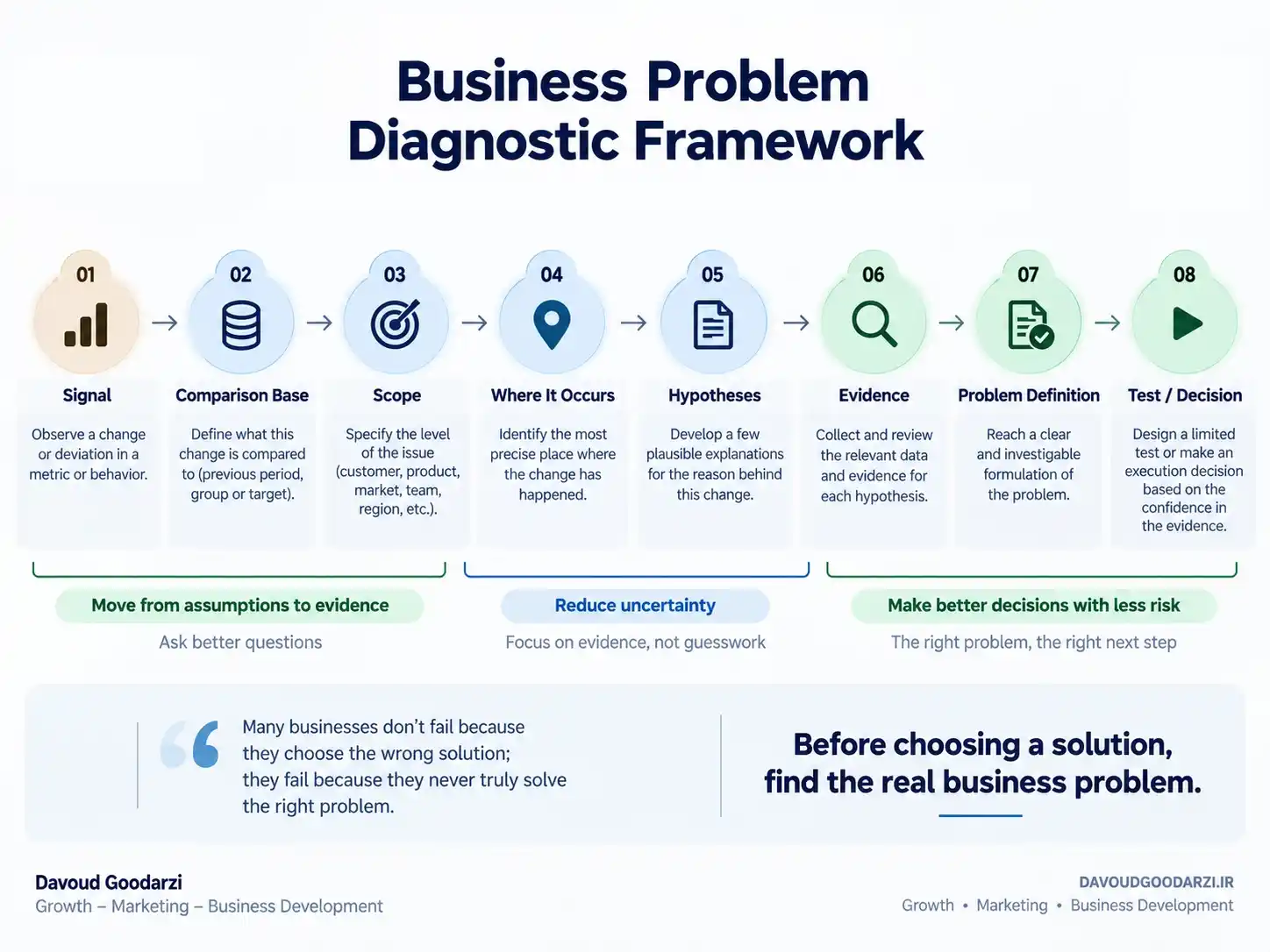
A seven-stage path from signal to decision
What changed, and compared with what?
Where is the change concentrated?
What competing explanations could account for it?
What supports, contradicts, or is still missing for each hypothesis?
What can we defensibly say about the problem right now?
What is the smallest investigation or probe that could reduce the most important uncertainty?
Should we act, test, investigate further, or stop?
Three questions for your next management meeting
What exactly changed, and what is our comparison point?
Which parts of our current explanation are recorded facts, and which are still hypotheses?
Which missing piece of information would most change our next decision?
Those three questions can shift a meeting from “What should we do?” to “What needs to become clearer before we act?”
Find the real business problem before choosing a solution
The Business Problem Diagnostic applies this process to your own situation: identify what changed, establish a comparison point, locate where the change is concentrated, separate hypotheses from facts, and identify the evidence still missing.
The output is not a fabricated certainty or a diagnostic score. It clarifies four things: what we know, what we suspect, what we still need to learn, and the next best diagnostic step.
Run the Business Problem DiagnosticConclusion
Good management is not simply about choosing solutions quickly. It is also about improving the quality of the problem definition before committing resources.
Lower sales, weaker conversion, higher acquisition costs, or declining team performance can all be important signals. None of them, by themselves, reveal the cause.
A more defensible path is to measure the change, establish a baseline, narrow the location, build competing hypotheses, inspect supporting and contradicting evidence, and choose the smallest investigation that reduces the most important uncertainty.
Terms used in this article
- Baseline
- The comparison point used to interpret current performance or a current metric.
- Root Cause Analysis (RCA)
- A family of approaches used to investigate the underlying causes of a problem.
- 5 Whys
- A repeated “why?” technique used to move beyond an obvious symptom and examine a causal chain.
- A3
- A structured management and problem-solving process used to investigate, communicate, and act on a problem.
- Problem Framing
- The process of examining and defining a problem before committing to a solution.
Still not sure where the real business problem is?
If you can see the signals but it is still unclear where the problem actually sits, which hypothesis deserves investigation, or what evidence is missing before a decision, we can examine the problem more closely.
Start a professional conversation